Chesapeake Bay Executive Council Meets to Discuss Progress, Initiatives
Last Thursday, July 23rd, the Chesapeake Bay Executive Council met in Washington, D.C. to discuss progress, setbacks, and initiatives going forward for restoration of the Bay. The Executive Council is made up of governors from all Bay states and the Mayor of D.C., as well as heads of relevant federal agencies.
Present at Thursday’s meeting were: Virginia Governor Terry McAuliffe (the Executive Council Chair); D.C. Mayor Muriel Bowser; Maryland Lieutenant Governor Boyd Rutherford*; Pennsylvania’s Secretary of the Department of Environmental Protection, John Quigley*; and Delaware’s Secretary of the Department of Agriculture, Ed Kee. Also present were heads of various agencies: Administrator of the EPA, Gina McCarthy; Deputy Assistant Secretary of Fish, Wildlife and Parks in the Department of the Interior, Karen Hyun; Assistant Chief of the Natural Resources Conservation Services in the U.S. Department of Agriculture, Kirk Hamlin; and Chairman of the Chesapeake Bay Commission, L. Scott Lingamfelter.
The public meeting began with an introduction from Chesapeake Bay Program Director Nick DiPasquale. He mentioned the interconnectedness of all species and habitats in the Bay watershed, and the need for multi-state partnerships to protect and restore the Bay. Following his presentation, the Executive Council panel made brief comments on what had been discussed at the earlier private lunch. A short Q&A session from the press ended the meeting.
Most of the meeting was spent by council members reassuring the public that a lot of progress had been made to clean up the Chesapeake Bay, and that a lot more progress was required. However, a few specific initiatives were mentioned that shed some light on how restoration efforts might progress in the years to come.
The Council mentioned a riparian forest buffer resolution, and the need for partner states to increase compliance and enforcement among farmers to install riparian buffer zones along waterways. Going off of this, Chesapeake Bay Commission Chair, Lingamfelter, discussed livestock stream exclusion. While many Bay states, such as Virginia, have a majority of their farmers participating in livestock stream exclusion, there is still more to be done in the watershed. Lingamfelter calls for greater USDA support and outlined five actions he recommended to the Secretary of the USDA to ensure livestock stream exclusion is enforced throughout the watershed. These actions include educating farmers, increasing technical and financial assistance for fencing or riparian buffers, and making requirements more clear, and more of a priority.
The issue of funding restoration efforts came up several times during the meeting. Governor McAuliffe announced an increase in federal funding. The current Presidential Budget allocates $39.7 million, pending congressional approval, toward conservation and restoration in the Chesapeake Bay watershed, while the previous fiscal year allocated only $7.58 million. Maryland Lt. Governor Rutherford suggested creating more public-private partnerships to increase funding from the private sector. He mentioned a resolution to sponsor a symposium by the Bay and federal partners to further discuss this idea.
The panel ended with EPA Administrator McCarthy and Virginia Governor McAuliffe highlighting where more efforts need to be made, such as urban stormwater runoff and agriculture, and the need for Bay states and partners to share their best practices with each other to improve water quality throughout the watershed.
This meeting was the first for many Executive Council members who had been newly elected as representatives for their states or cities in 2014. This excuse was used to explain why timetables for the next two-year milestone (2015-2017) were yet to be released. (Milestones are due to come in to the EPA in mid-January of 2016). While more specifics on timeframes and restoration plans would have been appropriate, the meeting did provide some insight on what Bay states will be focusing on over the next couple of years to improve the health of the Chesapeake Bay.
* Virginia Governor Terry McAuliffe was the only governor present at Thursday’s meeting. Maryland’s Lieutenant Governor Boyd Rutherford stepped in for Governor Larry Hogan as he underwent medical treatment. Pennsylvania’s Secretary of the Department of Environmental Protection, John Quigley, represented his state as Governor Tom Wolf was held up in Harrisburg, attempting to finaliz
Crabbing on Antipoison Creek
By Gary Greenwood
As Katie pointed out in a previous post, some restaurants in the Washington area were reporting a shortage of crabs. When I was down at our house on Antipoison Creek, I stopped by to see Glenn, one of the local crabbers, to see how many crabs he was catching.
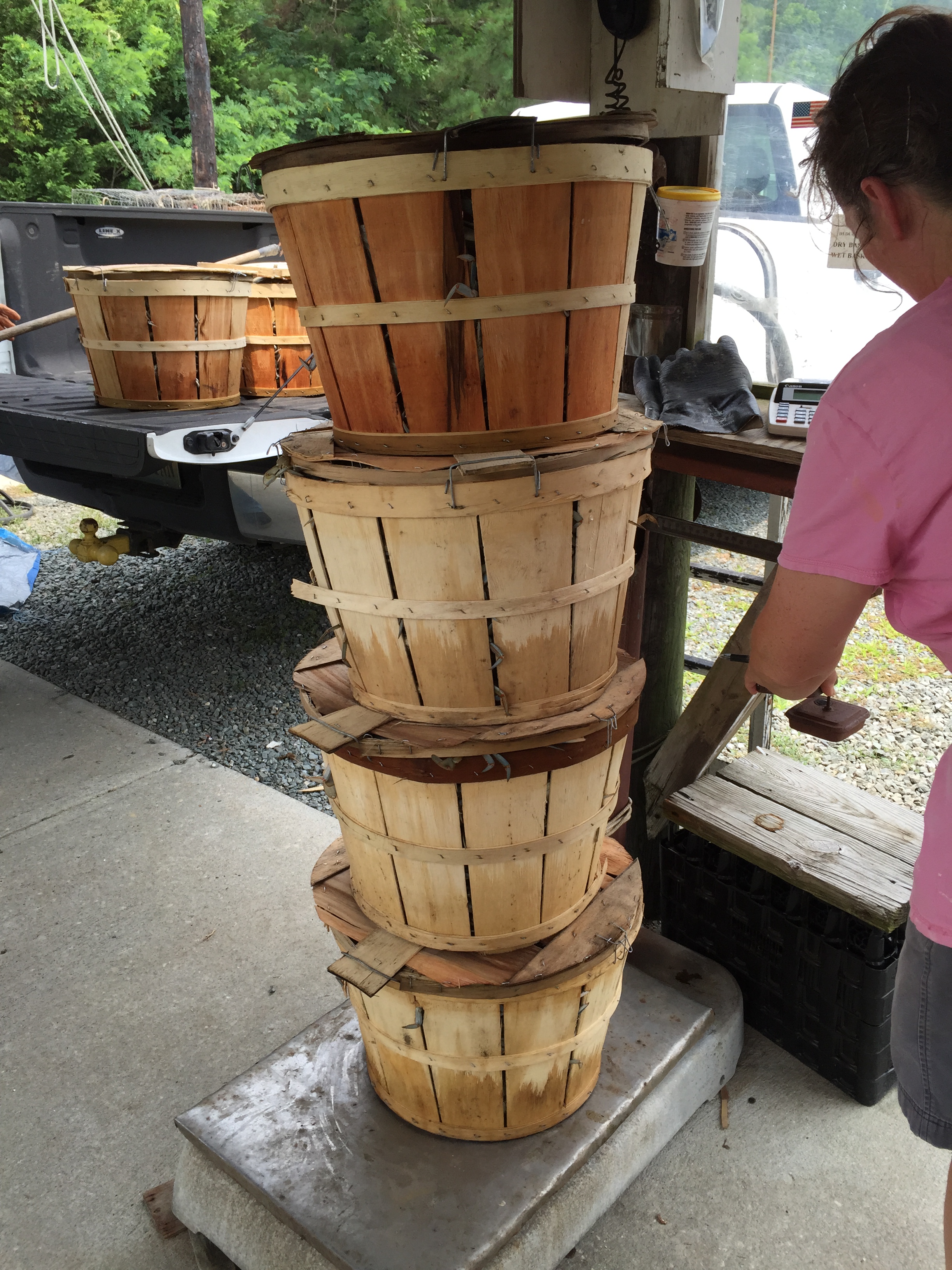
On July 2, Glenn brought in nine bushels of crabs from more than 150 pots. He considered that a good day, and said he had had a pretty good June as well. I rode with him as he delivered the crabs to his buyer and then picked up bait for his next trip out. Glenn had four bushels of #1s, three bushels of #2 and 2 bushels of #3 crabs.
The first picture shows the buyer weighing the four bushels of #1 jimmy crabs. Each bushel is marked as to the type of crab it contains. #1 are mature jimmy (male) crabs. These are often sold intact for steamed crabs. #2 jimmy crabs are younger male crabs, probably used for crabmeat. The #3 crabs are mature sooks (females). The price paid for a bushel depends on the type of crab, as well as the time of year and market.
The buyer was waiting for one more waterman to drop off his crabs, and then he would load the day’s catch into a refrigerated truck to take to the Little River Seafood processing plant up in Reedville.
After the bushels were weighed, Glenn picked up nine empty baskets, and we headed back to White Stone to pick up bait at a local fish warehouse. Glenn uses menhaden to bait his crab pots, and we picked up five 50-pound boxes of frozen menhaden. We stored those in an insulated box on the dock, ready to be loaded on the boat for the next trip out. Buddy, the blue heron that hangs out at Glenn’s fish house talked us into giving him one of the menhaden, which he promptly stabbed with his beak.

A Review of Virginia’s TMDL Assessment
By Neil Saunders
Given the EPA’s recent interim assessment of the Bay States’ ongoing implementation of the Chesapeake Bay TMDL and the Third Circuit’s affirmation of the legality of the Bay TMDL, it is worthwhile to take a closer look at the findings of Virginia’s water quality assessment. While this assessment is relevant to the Chesapeake Bay TMDL, in that any sub-watersheds belonging to the Chesapeake watershed apply to the Bay TMDL, it encompasses all of the waterbodies in Virginia- not only those belonging to the Bay watershed.
Virginia may be on track towards Bay TMDL implementation, but current water quality in the state is still far from healthy. According to Virginia’s Department of Environmental Quality (“DEQ”) 2014 water quality assessment, a significant percentage of rivers, lakes, and estuaries are “impaired” in three out of the six designated uses in Virginia: recreation, aquatic life, and fish consumption.
The assessment sites the presence of E. Coli from agriculture, urban runoff, leaking sanitary and storm sewers, and domesticated animals as primarily responsible for the impairment of the recreation use. For aquatic life, low levels of dissolved oxygen concentration and nutrient enrichment are the primary cause of impairment. Specific causes for impairment of fish consumption are mercury and PCBs (polychlorinated biphenyls). The remaining designated uses are shellfishing, public water supply, and wildlife, which have a much lower percentage of impaired waterbodies.
Additionally, a vast majority of lakes (81%) and estuarine waters (75%) tested are impaired for at least one designated use. River waters have a lower percentage of impairment (17%), but this figure does not take into account the 78% categorized as non-assessed due to insufficient data. DEQ utilizes two methods of data collection: DEQ-approved monitoring, which includes all monitoring performed by DEQ or individuals approved by DEQ, and lower quality, DEQ-non-approved monitoring, which includes outside data collection by citizen groups, the private sector, and other government organizations. Both types of monitoring play an important role in DEQ’s overall assessment methodology (p. 4). It is not clear from the report, however, why so much data for river waters are insufficient to assess.
The VA DEQ 2104 assessment is based on six years of monitoring between 2007 and 2012. The Clean Water Act requires every state to submit to the EPA a biennial review describing the quality of their navigable waters. Virginia uses a monitoring schedule that covers 1/3 of all waters every two years, so that all waters are monitored within a six-year period.
Unlike the EPA interim assessment, however, this water quality assessment provides a more accurate and immediate sense of what the Virginia’s water quality was in 2012. As the information in this report shows, despite Virginia staying on track for the most part to meet the Bay TMDL implementation targets, there is still a long way to go and a lot that needs to be done for the water quality to actually improve.
One of the biggest areas for improvement is monitoring. As stated earlier, almost 80% of river waters throughout the state are categorized as “non-assessed” due to lack of sufficient data. As a result, it is uncertain what percentage of these rivers are meeting their respective water quality standards, and what percentage are impaired or threatened. Unfortunately, a lack of sufficient monitoring- a problem which exists in most states- is more easily fixable in theory than in practice: understaffing at the agencies charged with conducting the water quality assessments as well as budgetary constraints severely limit the amount of waters that can be properly assessed.
One potential way in which monitoring can improve is through Virginia’s citizen monitoring programs. DEQ relies on citizen monitoring data to supplement its own data collection, and offers grant money to organizations through the state’s Citizen Water Quality Monitoring Grant Program. While DEQ cites 120 such organizations as providing data for the current assessment, not all data collected could be used because they did not meet DEQ’s assessment methodolgy or procedures. If more citizen-collected data could be used by DEQ, through additional citizen involvement and proper training, more waterbodies could be assessed, which would lead to more accurate assessments of water quality and more accurate changes to address water quality conditions.
Improved monitoring may not directly address other issues plaguing water quality, such as excessive bacteria or nutrient enrichment, but with more accurate assessments, Virginia can more effectively manage its regulatory framework to achieve greater reductions in pollution and better meet the goals of the Clean Water Act and Bay TMDL.
The information in this post was acquired from the report available on VA DEQ’s website: http://www.deq.state.va.us/Programs/Water/WaterQualityInformationTMDLs/WaterQualityAssessments/2014305(b)303(d)IntegratedReport.aspx#factsheets.
Chesapeake Bay Clean Water Blueprint Upheld in Court
By Neil Saunders
Earlier this month, the Court of Appeals for the Third Circuit upheld the legality of the Chesapeake Bay TMDL, securing the EPA and Bay States’ authority to continue with implementation of the Bay TMDL throughout the Chesapeake Bay watershed. This long awaited decision- oral arguments were held in November 2014- is huge news for the Bay community.
The case involved a challenge to the Bay TMDL from within the agricultural community and the governments of 21 states. At issue in this case was the statutory interpretation of the term “total maximum daily load” as used under the Clean Water Act. A total maximum daily load (or “TMDL”) is a document created whenever a waterbody is classified as “impaired” under the Clean Water Act. The document identifies the amounts of various pollutants that can be safely absorbed by that waterbody. The Bay TMDL, in particular, is one of the most detailed and comprehensive TMDLs that the EPA has written.
The challengers argued that use of the word “total” meant that the EPA could only prescribe a single, total amount of a pollutant that a waterbody could healthily absorb, and that, therefore, the EPA exceeded its authority when it created the Bay TMDL with the level of specificity it contains and the various accountability mechanisms it enforces. The Bay TMDL includes, in addition to totals of pollutants, timelines for compliance, requirements that the Bay States provide reasonable assurances that certain practices will be implemented on time, and “backstop” measures which the EPA will enforce if states do not remain on track. The challengers maintained that the EPA went beyond its authority, and that such authority belongs to the states. The EPA and other environmental organizations supporting the Bay TMDL countered that the EPA’s interpretation is a lawful exercise of its delegated authority.
In its decision the court found in favor of the EPA on all points, relying on a judicial doctrine commonly known as Chevron deference (after the seminal 1972 Supreme Court case Chevron v. Natural Resources Defense Council). That doctrine states that where Congress delegates an agency to implement a law, and Congress’s intent is unclear as to a provision of that law, a court must give deference to the agency’s lawful interpretation, so long as that interpretation is reasonable. In other words, if a statute is ambiguous an agency may apply its own interpretation as long as it is a reasonable one. In this case, the court held that the Clean Water Act does not define the phrase “total maximum daily load,” and that “[e]stablishing a comprehensive, watershed-wide TMDL—complete with allocations among different kinds of sources, a timetable, and reasonable assurance that it will actually be implemented—is reasonable and reflects a legitimate policy choice by the agency in administering a less-than-clear statute.” (Court’s decision pp. 59-60).
The court also addressed broader concerns about this case, namely the balance of power between the Federal and state governments. This case carries significance outside the Bay area because the EPA is likely to begin a similar TMDL process for other large watersheds in the country, such as the Mississippi River. It is because of this that so many state governments intervened in this case to challenge the Bay TMDL. But as the court acknowledged in its conclusion, “Congress made a judgment in the Clean Water Act that the states and the EPA could, working together, best allocate the benefits and burdens of lowering pollution. The Chesapeake Bay TMDL will require sacrifice by many, but that is a consequence of the tremendous effort it will take to restore health to the Bay—to make it once again a part of our “land of living,” Robert Frost, The Gift Outright line 10—a goal our elected representatives have repeatedly endorsed.” (Court’s decision p. 60). This are powerful words coming from a Court of Appeals, and provide an sense of optimism as the Bay States gear up for Phase III of the Bay TMDL in 2017.
This case was an appeal from a 2013 decision in which the lower federal district court initially upheld the legality of the Bay TMDL.
An Update on CBF vs. VA : A Setback to Virginia Water Quality
The Richmond Circuit Court judge who heard the Chesapeake Bay Foundation (CBF) vs. Virginia lawsuit earlier this month has ruled against CBF’s plea to keep livestock out of state streams and rivers. The decision allows large livestock farmers, particularly cattle farmers, to give animals unfettered access to Chesapeake Bay tributaries. Virginia has pledged to institute Best Management Practices (BMPs), including the use of stream buffers and fences on farmlands, to reduce nutrient and sediment loads to the Bay. This ruling, however, impedes the institution of such practices, and threatens water quality in the watershed.
CBF sued the Virginia Department of Environmental Quality and the State Water Control Board over the passing of the Virginia Pollution Abatement Permit- a permit that regulates animal waste management for animal feeding operations. The permit fails to address the need for large livestock farms (i.e. 200-300 cattle) to put into place stream buffers and fencing that would keep livestock out of streams and rivers on these farms. (Please see this post from July 1). Without buffers and fencing, livestock can deposit waste directly into waters, and can erode stream banks, putting excess sediment into the watershed.
The lawsuit, heard on July 9, was dismissed by Judge C.N. Jenkins. While CBF argues that free-roaming livestock can “apply” their waste directly to streams, the judge believes that application of manure can only refer to the spreading of waste by livestock farmers.
Cleaning up Baltimore’s Inner Harbor with Old (and New) Technology
By Neil Saunders
In Baltimore’s Inner Harbor an ancient technology is being used to clear trash and debris from its waters: the water wheel. Situated where the Jones Falls River meets the Inner Harbor, the water wheel uses a combination of hydropower and solar power to scoop up cigarette butts, plastic bottles, Styrofoam, and other floating trash flowing down the Jones Fall River. The wheel, created through the Healthy Harbor Initiative, has proved remarkably effective, removing over 200 tons of trash since May 2014.
This water wheel shows how even simple, small-scale projects, when successfully implemented, can achieve positive results in the Bay. Relying on hydropower from the river’s current, and solar power from panels attached on top of the structure when the current is slow, the water wheel combines a millennia-old technology with a newer, fast-evolving technology to remove trash and debris entering the Inner Harbor and ultimately the Bay. The water wheel powers a conveyor belt, which collects the debris into a floating dumpster. When the current is moving quickly after a storm, the dumpster can fill in a couple of hours.
The water wheel has proved so successful that plans to add more water wheels throughout the Bay are under way.
The water wheel was built by Clearwater Mills, LLC and owned by the Waterfront Partnership of Baltimore. Trash collected is then removed handled by the City of Baltimore Department of Public Works.


For a news video feature on the water wheel, visit: https://www.youtube.com/watch?v=RkQbcrzyAeE.
Chesapeake Bay Foundation Files Suit Against Virginia
Kudos to the Chesapeake Bay Foundation (CBF) for moving ahead on a major water quality issue in Virginia. This week CBF filed suit against Virginia’s Department of Environment Quality (DEQ) and the State Water Control Board over failure to enforce state regulations for livestock farmers.
One of the management practices Virginia has said it will implement to reduce water pollution in the Chesapeake Bay watershed is making sure all farmers keep their livestock out of streams and rivers through the use of fences and stream buffers. CBF has found that many Virginia livestock farmers are not implementing these management practices. This is thanks to the Virginia Pollution Abatement Permit, approved last year by the DEQ and the Water Control Board for a ten-year period. This permit does not require the state’s largest livestock farms (cattle, pig, poultry) to fence and buffer streams to which the livestock have access.
CBF’s challenge to the DEQ and the State Water Control Board, should it be upheld in court, will improve a flawed permitting process, ensure that Virginia does its part to reduce water pollution, and ultimately improve the health of the Chesapeake Bay.
Fencing off streams and rivers from livestock reduces water quality issues in the tributaries and mainstem of the Chesapeake Bay. When livestock have wading access to bodies of water, they are able to pollute streams and rivers with their waste, adding to the nitrogen and phosphorus runoff that enters the Bay. Livestock also erode stream banks, depositing sediment directly into the water, which makes its way downstream and eventually reaches the Bay.
By allowing farms to give their livestock access to streams and rivers, the DEQ and State Water Control Board are not enforcing the State Water Control Law, which calls for a reduction and prevention of water pollution. Furthermore, by not enforcing regulations that curb nitrogen, phosphorous and sediment runoff from agriculture, Virginia is violating its agreement with the EPA (in the Clean Water Blueprint) to reduce nutrient and sediment pollution entering the Bay from state waters.
The Richmond Circuit Court will hear arguments for this case this Thursday, July 2. Updates to come.
The original press release from CBF can be found here.
The Chesapeake Bay’s Blue Catfish Problem
A growing blue catfish population in the Chesapeake Bay Watershed is depleting the Bay’s native fish population. Regional restaurants, markets and nonprofit organizations are stepping up to this challenge, and offering this invasive species to consumers as a tasty, affordable alternative. Does a higher demand for blue catfish provide a solution to this environmental issue?
The blue catfish is a major predator of the blue crab population in the Chesapeake Bay and its tributaries. The VMRC has named the growing blue catfish population as one of the factors responsible for the low harvest numbers for crabs this year. Originally from the Mid-West, native to the Mississippi, Missouri, and Ohio Rivers, the blue catfish was brought to Virginia in the 1970s and 80s as a sporting fish. Stocked in the York, James, and Rappahannock Rivers, the fish has since spread north, to the Potomac River, infiltrating both Virginia and Maryland waters.
The blue catfish thrives in freshwater, in the Chesapeake Bay’s major Southern tributaries, but can also live in brackish, tidal waters. Since the blue catfish is an invasive species in the Chesapeake Bay Watershed, it has no natural predators in this estuary. An unchecked population can do a great deal of damage to the underwater ecosystem, by preying heavily on shellfish, menhaden, white perch and fish eggs (such as shad), and competing for resources with native fish.

Spawning from late May into June, females of reproductive age release 4,000 to 8,000 eggs per kilogram every year. This can be quite a lot of eggs considering the large size of catfish. The largest catfish caught in Maryland was 84 pounds, while Virginia has recorded the catch of a 140-pound catfish.
While a 2012 Maryland Department of Fisheries report recorded an annual catch of 400,000 pounds of blue catfish, this has not been enough to reduce the environmental damage caused by this invasive species in our watershed. As a response to this issue, many area restaurants and markets have embraced the idea of selling locally caught blue catfish to help reduce the Bay population. Whole Foods and MOM’s Organic Market began to sell this fish in 2014, while restaurants such as Clyde’s, and other popular D.C. restaurants, now offer catfish on their menu.
A regional nonprofit, Wide Net Project, has also found a way to address this environmental issue, and works to build up the market for blue catfish. Wide Net Project works with regional markets, restaurants, and food service companies, marketing the blue catfish as a local, sustainable, tasty and inexpensive food item. In addition, this nonprofit works to stock local hunger relief organizations with the fish. A quarter pound of blue catfish is donated for every pound sold. In 2015, Wide Net Project is expecting to sell 75,000 pounds and donate tens of thousands of pounds of blue catfish.
A Review of the EPA’s Assessment of Virginia’s Bay Cleanup Progress
By Neil Saunders
According to the EPA’s recent interim assessment of pollution in the Chesapeake Bay, Virginia is on track to meet its TMDL targets for both nitrogen and phosphorus, but is off track to meet its targets for sediment. Three out of four sectors- agriculture; wastewater treatment plants and onsite systems; and offsets and trading- are under the lower “ongoing oversight” designation, with the remaining sector- urban/suburban storm water- under the intermediate “enhanced oversight.” According to the EPA’s “Next Steps,” urban/suburban storm water may be upgraded to “ongoing oversight” in 2016 provided Virginia completes certain MS4 (define) permitting requirements.
What do these results mean going forward? At this stage in the overall TMDL process, it is an encouraging sign that Virginia, which contributes significant nutrient levels to the Bay, is on track to meets its 2017 targets for nitrogen and phosphorus. It is also encouraging that Virginia appears close to receiving an upgrade in oversight level for the urban/storm water sector, which would place all of the state’s programs under the lower “ongoing oversight” level. Until all practices are in place (which isn’t expected until 2025), this is generally what we hope to see in all of the Bay States’ interim assessments.
Despite the largely positive results, however, there are still areas where Virginia can improve. Sediment levels remain an issue for the state, and will require additional measures to achieve the necessary reductions targets by 2017. This will likely prove challenging, given the fact that the EPA’s current projections of sediment levels over the past decade are higher than were initially anticipated, meaning more sediment has been entering the Bay than previously thought. Another concern is that, although the EPA’s model projections place the state’s agriculture practices on track to meet the 2017 targets within that sector, the fact that Virginia maintains a voluntary approach to nutrient management makes it difficult to accurately measure. The EPA expects that Virginia will work with the Chesapeake Bay Program Office to “project the necessary pace of voluntary agriculture program implementation to stay on track with nutrient and sediment reduction goals and set milestones accordingly.”
The interim “results” are based largely on models that project future nutrient and sediment levels, and incorporate many activities, or practices, that have not yet been implemented. Unless the states actually follow through on their commitments, many of the positive projections will be unrealized. Therefore, it is crucial that the states continue to take any and all additional measures that are necessary to restore the Chesapeake Bay. There is still a long way to go and a lot more that needs to be done.
The interim assessments were released to for the six Bay States’ 2014-2015 milestones. These assessments, which form part of the EPA’s overall accountability framework under the 2010 Chesapeake Bay Total Maximum Daily Load (TMDL) for the entire Chesapeake Bay watershed, play an integral role in evaluating the progress of the Bay States towards meeting their respective pollution reduction targets, and are used to identify areas of concern that require additional measures to meet those targets.
The EPA and Bay States are currently in Phase II of a three-phase, fifteen year process of the TMDL, which means that they are continuing to work towards implementing practices by 2017 that will meet sixty percent of the total pollution reductions needed to clean the waters of the Chesapeake Bay. The third and final phase is to be completed by 2025, and requires 100 percent of the pollution reductions measures to be in place.
A Review of the EPA’s Assessment of Maryland’s Bay Cleanup Progress
By Neil Saunders
According to the EPA’s recent interim assessment of pollution in the Chesapeake Bay, Maryland is presently on track to meet the 2017 TMDL reduction targets for two out of the three major pollutants in the Bay: phosphorus and sediment. Maryland is not on track to meet the target reductions for the third major pollutant, nitrogen. New information obtained by the EPA shows that Maryland is actually contributing more nitrogen to the Bay than previously thought. Therefore Maryland must plan to implement even more effective practices to ensure that it will meet its 2017 targets for nitrogen.
So what do these results mean for the Chesapeake Bay going forward? For one, Maryland is the only state currently under the lower “ongoing oversight” for each sector category that the EPA assesses: agriculture; urban/suburban stormwater; wastewater treatment plants and onsite testing; and offsets and trading. While this is far from encouraging overall, it does demonstrate that Maryland, the state most synonymous with the Chesapeake Bay, it making positive strides towards meeting its reduction targets. The EPA expects Maryland to implement additional measures to reduce nitrogen pollution.
Also, much of the progress made in Maryland, including the recently proposed phosphorus management regulations, still must be implemented to achieve the projected pollution reductions. At this stage in the TMDL process, many of the projections are based on practices that have yet to be implemented. It is critical, that Maryland continue efforts to put practices into place. Sometimes, this is easier said than done. Similar regulations to the Phosphorus Management Tool regulations have been pulled and/or delayed in the past (the environmental community has advocated for stricter phosphorus management for over a decade now), so it is crucial for Maryland and the Department of Agriculture to follow through with implementation.
The interim assessments were released for the six Bay States’ 2014-2015 milestones. These assessments, which form part of the EPA’s overall accountability framework under the 2010 Chesapeake Bay Total Maximum Daily Load (TMDL) for the entire Chesapeake Bay watershed, play an integral role in evaluating the progress of the Bay States towards meeting their respective pollution reduction targets, and are used to identify areas of concern that require additional measures to meet those targets.
The EPA and Bay States are currently in Phase II of a three-phase, fifteen year process of the TMDL, which means that they are continuing to work towards implementing practices by 2017 that will meet sixty percent of the total pollution reductions needed to clean the waters of the Chesapeake Bay. The third and final phase is to be completed by 2025, and requires 100 percent of the pollution reductions measures to be in place.
 Chesapeake Bay environment and water quality blog