Uncategorized
Recycling the Leftovers
Link Posted on
This past weekend the New York Times had a piece about recycling food waste from restaurants, college dining areas, and other businesses associated with food production. The article focused on efforts to reduce food waste through composting, or donating leftovers to food banks. Cities, such as Austin, Texas, and colleges, such as Dickinson College in Pennsylvania, are participating in programs where food waste is being recycled into compost for fertilizer. Dickinson is unique in that it owns and operates a college farm, where waste from dining services can be composted and used to fertilize crops (which are then used in the school cafeteria).
Using food waste for compost, or donating leftovers to food banks, can reduce the millions of tons of waste sent to American landfills each year from restaurants, households, and the food production industry.
In the News
What I’m reading this afternoon:
The Atlantic States Fisheries Commission is considering putting additional limitations on the catch of striped bass (rockfish). The rockfish population in the Chesapeake Bay is currently not considered overfished, however the Commission will likely establish a three year timeframe, reducing fish mortality rates in order to raise the population to a healthier number. These limitations will impact the fishery along the Atlantic Coast, including the Chesapeake watershed. A news release for a draft addendum was released May 16. (Atlantic States Marine Fisheries Commission).
Related: The Capital Gazette write-up on the rockfish news release, “Fisheries panel could limit rockfish catch in three year phase-in” (Capital Gazette).
Regulation is moving forward for Dominion Resources in their efforts to export liquefied natural gas out of Cove Point. The Federal Energy Regulatory Commission (FERC) has found that exporting natural gas from the facility in Maryland will not have a significant environmental impact. However, the FERC has opened a 30 day public comment period, that started May 15, for those with concerns. Many environmental groups oppose this development, for the risks to air and water pollution export operations could bring to the area. (The Bay Journal)
Plans move ahead for the development of wind energy project off of Eastern Shore, as Maryland Governor vetoed a bill last Friday that would have delayed construction (Baltimore Sun)
Great News for Chesapeake Oysters
Link Posted on Updated on
Great News for Chesapeake Oysters
According to the Maryland 2013 Fall Oyster Survey, released by the Maryland Department of Natural Resources, the oyster population in the state is at the highest its been since 1985. Last year’s harvest was over 400,000 bushels, and the oyster survival rate has risen to 92% with the development of disease resistant larvae.
Related: Maryland Department of Natural Resources Press Release
Update on Challenge to Chesapeake Cleanup Plan
There have been some recent updates and articles on the appeal of the EPA’s Chesapeake Bay cleanup plan, brought forward by the American Farm Bureau Federation, et. al. Today’s post from the Chesapeake Bay Foundation gives a summary of the issue, and provides links to the amicus briefs filed for the upcoming case.
The Washington Post also issued an article, listing entities involved with the cleanup plan, Maryland, Virginia, Delaware and the District of Columbia, as defenders of the cleanup plan. West Virginia has now joined with the American Farm Bureau Federation, while New York and Pennsylvania (where the case will be heard) have so far not spoken out for either side. According to the Post, twenty other states are opposed to the Chesapeake cleanup plan, and include Alabama, Alaska, Arkansas, Florida, Georgia, Indiana, Kansas, Kentucky, Louisiana, Michigan, Missouri, Montana, Nebraska, North Dakota, Oklahoma, South Carolina, South Dakota, Texas, Utah and Wyoming. However, various cities and organizations within these states have publicly defended the cleanup plan and the EPA’s authority to regulate pollution limits in the region. The case is scheduled to be heard this summer.
Recent Headlines
Reading list for this afternoon:
Value of Virginia Aquaculture Reaches All-Time High (VIMS)
Oyster Aquaculture Could Combat Potomac River Pollution (Chesapeake Bay Program)
Chesapeake Bay Grasses Up, But Not in Anne Arundel (Capital Gazette)
CBF Issues a Statement on New Amicus Briefs Filed in Support of the Blueprint (Chesapeake Bay Foundation)
Baltimore, Other Big Cities Back EPA in Bay Cleanup Dispute (B’More Green)
The State of Underwater Grasses in the Bay
Yesterday the Chesapeake Bay Program released their annual report on the abundance of underwater vegetation, and several news agencies have been sharing the results. I heard a piece on WAMU this morning on the Chesapeake Bay Program’s findings. In the 2012-2013 timeframe, underwater grasses increased by 24%, and up to 12,000 acres. Widgeon grass was the most successful in the middle Bay over this period, (between the Honga River to Pocomoke Sound), while eelgrass saw a smaller recovery.
Widgeon grass and eelgrass are found in waters with higher salinity. As the Chesapeake has four different salinity zones, there are a variety of underwater grasses that grow in the bay. Grasses such as wild celery are found in the lower reaches of the Potomac River. Widgeon grass and eelgrass are found in the middle and lower bay.
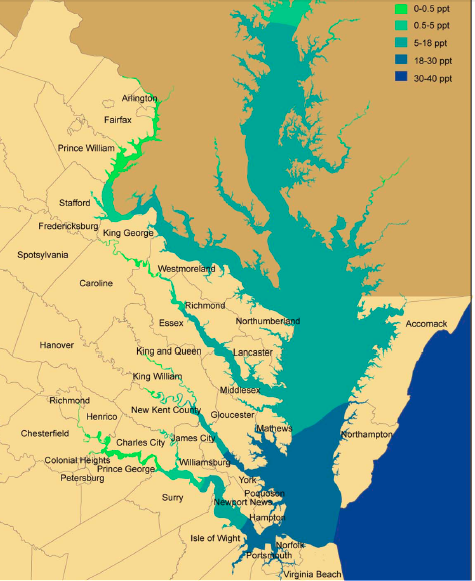
(Image from virginiaplaces.org/watersheds/)/
Underwater grasses are extremely important to aquatic species and the overall health of the Chesapeake. The grasses are a food source and offer habitat for the Blue Crab and several fish species. The long-term trend of seagrass decline was credited as a potential reason for the low crab abundance in recent years. Juvenile crabs are more susceptible to predators in areas where the seagrass has disappeared. Grasses also help to prevent erosion, and absorb nutrients in the water. Underwater seagrass is threatened by polluted runoff and a lack of sufficient light.
The Virginia Institute of Marine Science (VIMS) does a lot of research on underwater grasses, and has been tracking their abundance in the bay for years. Their findings are included in the Chesapeake Bay Program report.
See:
Rise in Shad Returning to Potomac River
Link Posted on
Rise in Shad Returning to Potomac River
The Chesapeake Bay Program had a piece today on the rising numbers of shad returning to the Potomac River. A return of native fish to the region can signify an improvement in water quality conditions.
Update on the Cheapeake Bay Cleanup Plan
I shared news several weeks ago on the Chesapeake Bay Cleanup Plan, put forward by the EPA, which is being challenged by the American Farm Bureau Federation and other agricultural lobbyists. Just as a refresher, the American Farm Bureau et. al. is challenging the EPA’s ability to establish pollution limits and enforce related restoration efforts in the Chesapeake Bay. Most of the plantiffs are located west of the Chesapeake Bay watershed, and are not affected by standards set in this region. However, there are a lot of large scale agricultural groups challenging the Bay Cleanup Plan, as they fear legislation in the Chesapeake watershed could become a precedent in their own watersheds.
Many actors in the Chesapeake Bay watershed have a very different outlook on the issue. Legislators have been working with various interest groups, including smaller scale agricultural groups, to set reasonable pollution limits. Organizations like the Chesapeake Bay Foundation has issued a petition against the outsider states that have been interfering in the Bay Cleanup Plan. State legislators in the Chesapeake watershed have stood with the Chesapeake Bay Cleanup Plan, most recently the Virginia Attorney General, Mark Herring. The attorney general filed a friend-of-the-court brief last Thursday, declaring that Virginia will defend the EPA’s regulatory abilities in the case of the Chesapeake Bay Cleanup Plan. (A link to the brief can be found at the Chesapeake Bay Foundation).
Mid-Week News Roundup
Some articles I’ve been reading today from various sources on Chesapeake Bay news:
Chesapeake Bay Program: “Conserving waterfowl habitat at Mallard Haven River Farm”
B’More Green: “Bill to Protect Pax River could scuttle Eastern Shore wind project”
Washington Post: “EPA proposes greater protections for streams, wetlands under Clean Water Act”
And several from the Bay Journal:
“Shell shortage leaves some oystermen unhappy with their options”
“D.C. mayoral candidates take their stance on the environment, Anacostia”
“Virginia puts the brakes on proposed route that would impact wetlands“
How Does Salting Our Roads in the Winter Impact our Waters?
Earlier this week the Northern Virginia area had quite a few inches of snowfall. This was likely one of our last storms now that it’s officially spring. After the snow melts, and the days get warmer, we can still see the impacts of snowstorms on our watershed. This afternoon I’ve been reading the EPA’s blog for Healthy Waters of the Mid-Atlantic Region on the impacts of road salt on our streams, rivers, and the Chesapeake Bay. (“Recovering from a healthy does of winter“).
The impact of salt runoff is greater in freshwater systems than saline. The Bay has a mix of freshwater and saltwater estuaries. The more saline waters and species are less likely to be affected by salt runoff. However, in freshwater, salt can lower oxygen levels and increase conductivity, directly impacting aquatic life and macroinvertebrates. Salt runoff can also affect human drinking supplies and human health, should concentrations get too high.
The post includes tips on how to remove excess salt from driveways and roads, and links to previous advice on smart ways to apply salt, with minimum impact (for future reference).
 Chesapeake Bay environment and water quality blog