Virginia
Oyster Farming on Antipoison Creek
Last spring I worked on a report on the impacts of oyster acidification on the Eastern Oyster (Crassostrea virginica) population in the Chesapeake Bay. To get some background information on the oyster growing process, I visited with a neighbor who harvests oysters for consumption on Antipoison Creek. I wanted to share some pictures and my understanding of the oyster farming process from that project.
Farmer Mike grows over 40,000 oysters, off of his shore and dock, and further out, in the creek and Chesapeake Bay. Mike buys oyster larvae from a nursery outside Mathews, Virginia. The nursery produces Dermo-disease resistant triploid oysters. (A good story on the creation of triploids, and their differences from diploid oysters is here: Chesapeake Quarterly).
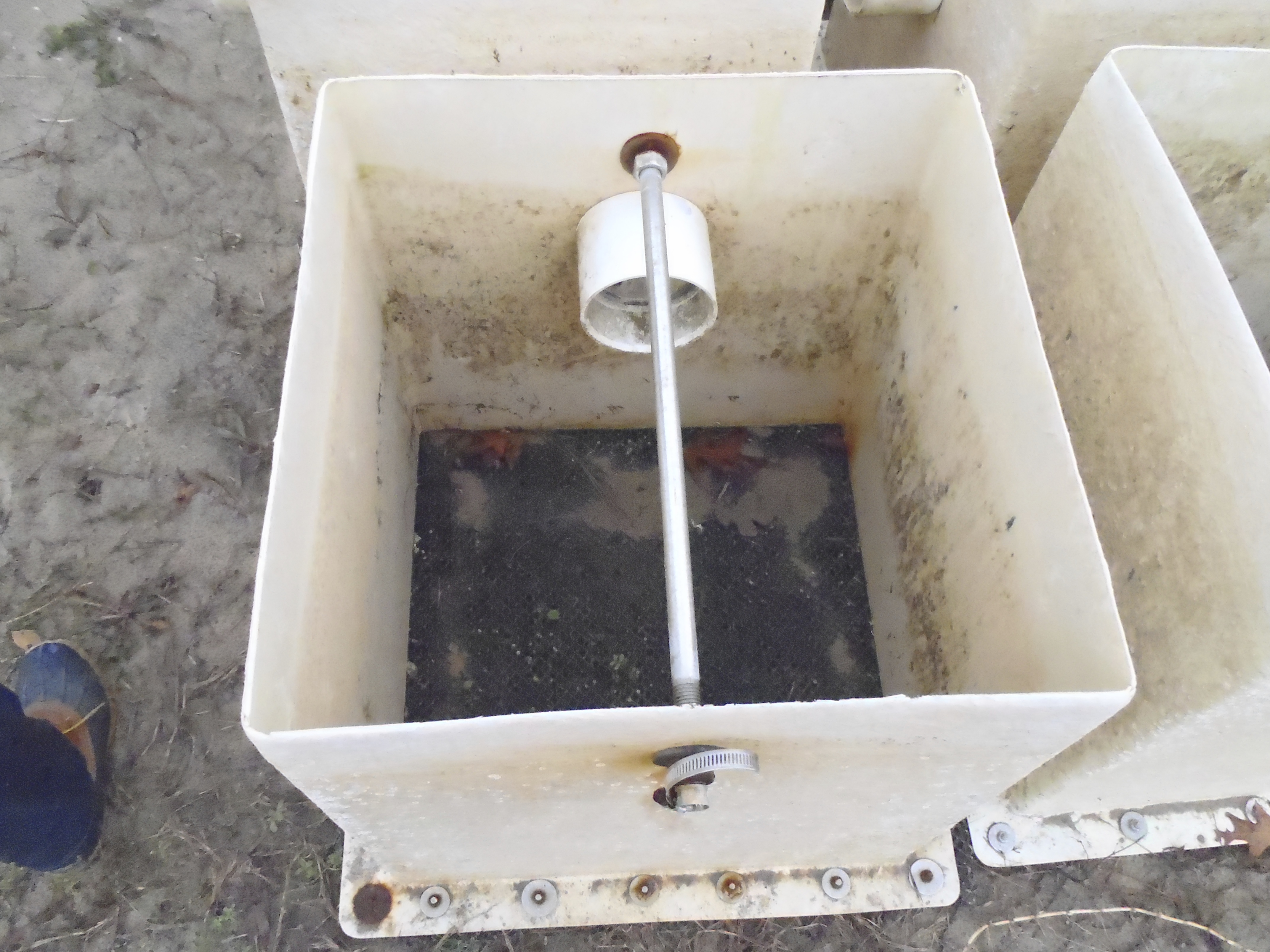
The larvae are raised in tanks, like the empty one above. When larvae attach themselves to a hard surface, which they must do to grow, they are called spat. Many farmers use a spat-on-shell approach; spat grow on oyster shells until they form their own shell, and are large enough to be moved. (Spat are less than 0.98 inches long; it can take up to a year for oysters to reach this size).


The oysters are then moved to a net or strainer, shown above. Mike keeps the strainers in floats, suspended in the creek and attached to his dock.
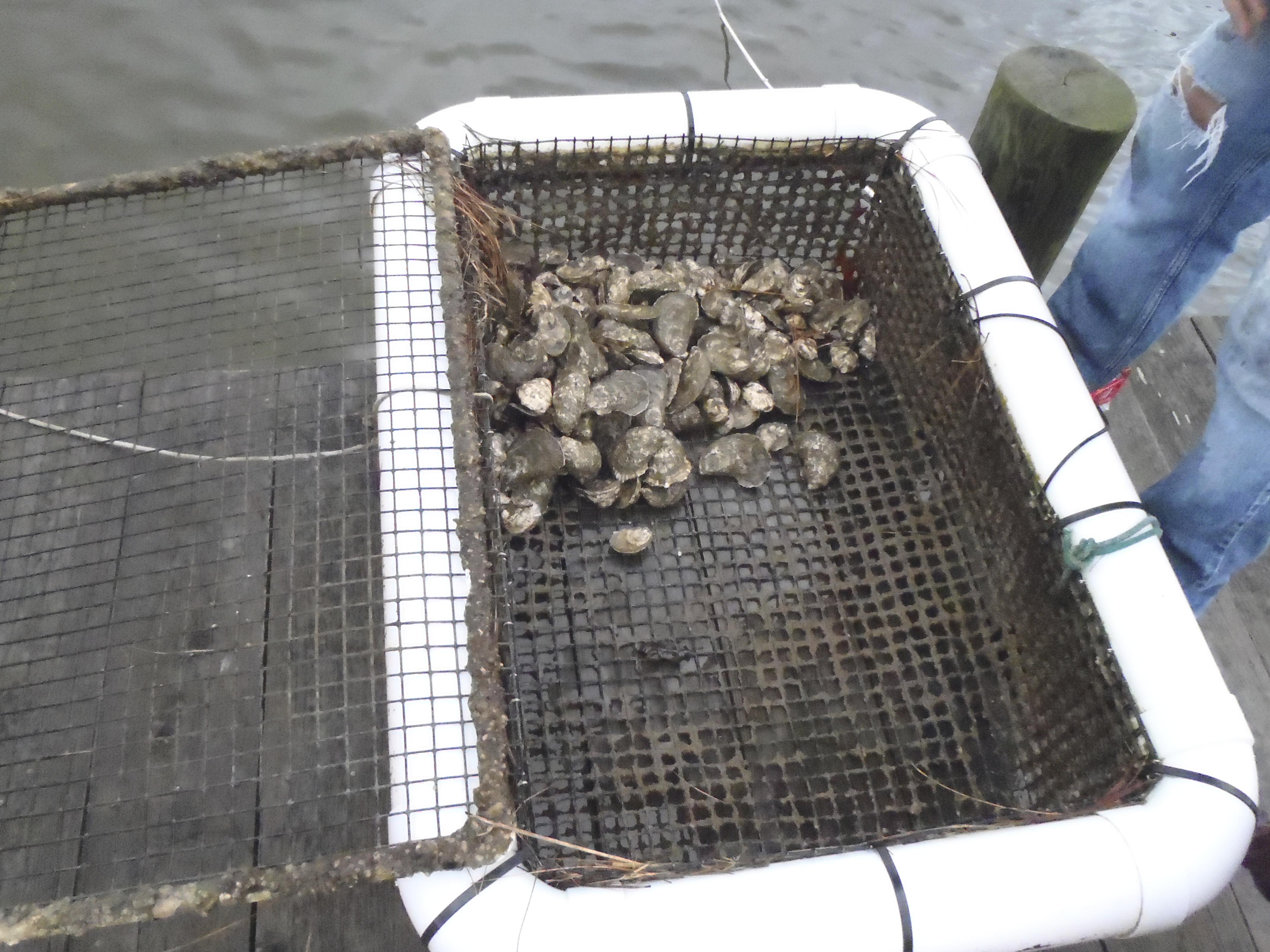
As the oysters grow, they are moved to larger cages, placed on the bed of the creek, and further out in the Bay. Separating oysters into cages at this stage reduces overcrowding and competition for food. It generally takes 2.5 – 5 years for an oyster to grow to market size ( 3 inches or longer). At this time, the oysters are collected, transported, and sold to local restaurants and markets.
Other interesting facts about the oyster farming process:
- Spawning occurs from May to September- water temperature must be between 64-68 degrees F.
- Oysters become dormant in colder water temperatures; they can survive freezing temperatures, if left submerged in water
- Oyster growth is dependent on salinity, water quality, water depth, temperature, and the presence or absence of disease, predators, sedimentation, food source
- Farmers, like Mike, must frequently test water quality, including dissolved oxygen levels, and concentrations of chlorophyll, which provides nutrients for oysters
- The oyster can grow up to 8 inches long, but is usually sold for consumption at 3 inches
Further reading on the Eastern oyster: NOAA.
Raising oysters requires a great deal of care throughout the year. I found a site on cage handling and maintenance that has seasonal instructions for raising oysters, and additional info on the farming process. (Severn River Association).
Appeal for Stronger VA Regulations on Stormwater Runoff
The Potomac Conservancy sent out a letter regarding stormwater runoff regulations for the Potomac River watershed. Stormwater management programs are set to go into effect on July 1, 2014, but legislators in the Virginia General Assembly are being asked to delay implementation. I am urging Virginia readers, along with the Potomac Conservancy, to send a message to your local representatives asking them to not to delay on stormwater management programs. I will post the Potomac Conservancy letter below, which includes a link to contact information for Virginia state legislators.
From the Potomac Conservancy:
|
No More Delays for Clean Water! |
|
That’s all! Thank you for taking action to help keep our nation’s river clean! |
Antipoison Creek: Past and Present
I think history is an important part of studying current environmental issues. The land use practices and consumer choices of past societies and generations shaped the environments we have today; studying historical descriptions of the places we live in can be used to compare past conditions with present.
In research for this SAV (Submerged Aquatic Vegetation) project (planting underwater grasses by the family Bay house), I have been looking at the historical presence of SAVs in the area, and have come across various historical facts on the area, some new, some old.
The house is at the mouth of Antipoison Creek, which opens up to the Chesapeake Bay. The Creek got its name when local Native Americans treated John Smith for a stingray injury. Smith was either treated at Antipoison Creek, or the cure was found at the creek- versions vary.
Agriculture and aquaculture have been prominent in Lancaster County for centuries. It’s hard to imagine the Antipoison Creek of Smith’s time. Today, farmers, watermen, oyster harvesters, vacationers and retirees surround the creek. How land use and the natural environment in the area has evolved and changed throughout the past 400 years is something I’m interested in, and could be important to future restoration/ conservation projects in the area.
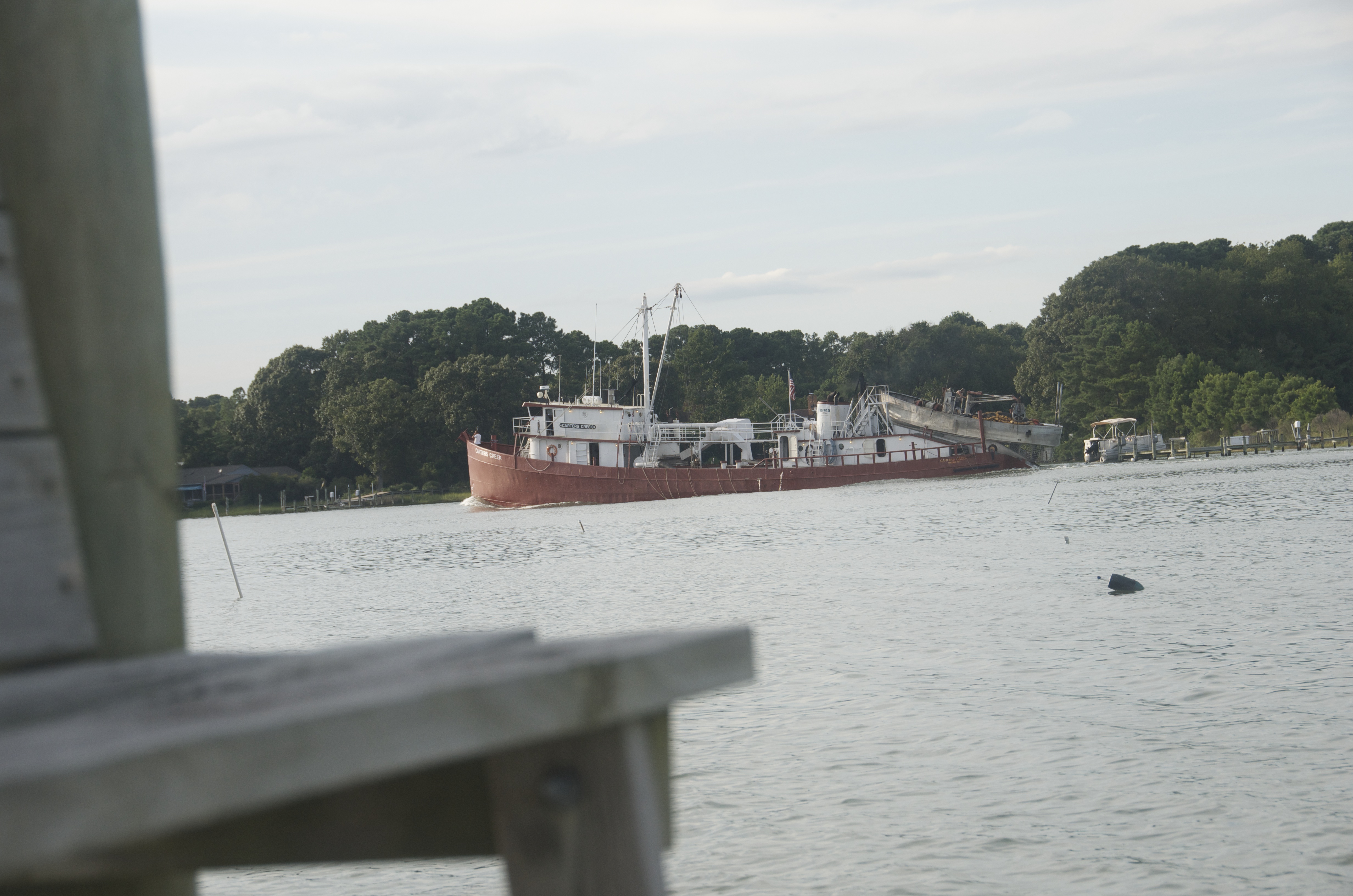
View from our dock of a fishing vessel that has a home on Antipoison Creek. To reach its wharf, the ship passes a variety of residential homes, fish houses, and a small oyster farm that are situated on the banks of Antipoison.
- ← Previous
- 1
- …
- 4
- 5
 Chesapeake Bay environment and water quality blog